Sunday, February 17, 2013

Karen Lord “The Best of All Possible Worlds” (Del Rey, 2013)

Ultimately this is a book about optimism.  Characters struggle and suffer, bad things happen, but the possibility for growth and happiness exists.

The plot is fairly simple.  Following a genocidal attack, Sadiri refugees on the planet Cygnus Beta are struggling to continue their existence as a distinct culture.  Their fundamental problem:  most of the women were killed in the attack, leaving the refugees with an extreme imbalance of male survivors.  In order to find an appropriate pool of potential brides, a joint delegation from the Sadiri community and the Cygnus Beta government travel around the world, visiting various locales in order to gather genetic samples.  

Lord’s story centers on two characters:  Grace Delarua and the Sadiri councilor Dllenahkh.  She’s warm and empathetic.  He’s cool and cerebral.   You can guess how it goes.  (But that’s OK.  Sometimes judicious usage of a trope plays off well, and this is one of those cases.)  Delarua is the primary POV.  Her personality shines through and builds the tone of the book.  Delarua’s empathy ensures that we are invested in the characters and through them in the small personal story that Lord tells.

Lord makes an interesting choice in TBoAPW.  Events that would be the core of most SF books are somewhat marginalized, and occur in the background. The destruction of the Sadiri home planet, kidnappings, the investigation of slavery, the prosecution of a telepath who has been manipulating others; we see the events only in the aftermath as they play out in the lives of our small group traveling around Cygnus Beta.

And so back to optimism.  We see the aftereffects of these various disasters and problems, but the focus in on overcoming them.  Rather than dwell on the negative, Lord gives us a story of survival and ultimately triumph.  We are given a tour of a world that has its share of problems, but are left feeling that these problems are solvable, and that ultimately it is possible to not just endure, but to create better lives.

The Best of All Possible Worlds is an outstanding novel, and quite frankly so accomplished that it is difficult to believe that it is only Lord’s second novel.  It’s rare to read such a humanized story of interstellar colonization, and rarer still to read one so polished.  It’s sure to be one of my favorite reads of 2013.

Tuesday, February 12, 2013

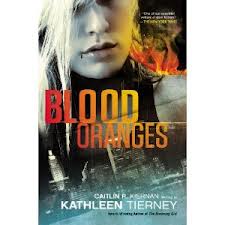
Kathleen Tierney "Blood Oranges" (Roc, 2013)


First things first:  Kathleen Tierney is the nom de urban fantasy of author Caitlin Kiernan.  Ms Kiernan is an extremely well regarded stylist, who primarily writes in the vein of “the weird”.  She has been nominated for the Bram Stoker Award, the World Fantasy Award, & the Locus Award, among many others.

The plot is bog standard urban fantasy.  Monster hunter Siobhan Quinn is bitten by a werewolf, then saved and bitten by a vampire, the Bride of Quiet, who intends to use Quinn for her own nefarious purposes.  Being a sassy monster hunter, Quinn doesn’t take kindly to this idea, & starts looking for answers and revenge.

On one level this is a breezy, if gritty, urban fantasy.  Quinn’s quest for answers and revenge pushes things along at a brisk pace.  The writing is very accessible, and suitably quippy for the genre.   What is ultimately more interesting is how Tierney uses this plot as a platform to deconstruct urban fantasy novels.  Quinn is absolutely not a Mary Sue.  She’s a homeless junkie who just accidentally got involved with monster hunting.  She’s not sexy (unless you like shark eyes, piranha teeth, & bits of blood and gore in someone’s hair).  She’s really not very good at it, and seems to succeed more from dumb luck than anything else.  The various supernatural characters are likewise not sexy, or protective, or anything remotely resembling some sort of potential life partner.  Instead, they tend to be horrific, with their own thinly veiled agendas that clearly are not in line with Quinn’s best interests.

A word needs to be said about the actual writing in Blood Oranges.  As Caitlin Kiernan, she is known for beautiful, at times rather ornate prose.  In her guise as Kathleen Tierney, she abandons this entirely.  Blood Oranges is told from the POV of Quinn, a junky and runaway who presumably hasn’t attended school since the age of 12.  The prose style reflects this character.  It is coarse and at times simplistic, but then that’s the point isn’t it?

Blood Oranges is a boot to the head of urban fantasy.  An angry, blood stained rebuke to the writers of simpering sparkly vampires and faux heroic heroines who love them.  It’s a blast of punk rock attempting to cleanse the airwaves from bloated soft rock balladry. 

Saturday, February 9, 2013

Richard Parks “Yamada Monogatari: Demon Hunter” (Prime Books, 2013)


Yamada no Goji is a supernatural detective in feudal Japan.  For a fee, he investigates situations involving various supernatural phenomena (foxes, ghosts, demons, trolls).  

A couple of things about the book will either make it or break it for you. First, this is a collection of short stories, not a novel.  This means that the readers’ expectation of character and plot development will not be fulfilled.  While there are some recurring characters and themes, there is no overall plot to this collection.  Yamada no Godji gets called in on a case, investigates, & moves on.  This can be frustrating, as each story just seems to be a variation on what came before, and not any sort of progression.

Second, the setting is unusual.  While recent years have seen growth in non-Western fantasy stories, the feudal Japanese setting is still rather unusual.  I am no expert on Japanese folklore or history, but my impression was that Parks dealt with these issues with sensitivity and a certain amount of accuracy.  But readers may be upset to discover that none of the typical Western tropes are in use here. (Although it’s possible to see how tropes could develop from this setting – the scheming courtier, the bandit, vengeful ghost, etc).

Laura Lam “Pantomime” (Angry Robot, 2013)


A quick disclaimer:  I’ve never been much of a YA reader.  But with the growth of the genre, I’ve checked out a few things & have been pleasantly surprised.  Pantomime, however, seems much closer to the core of the genre, & as such I’ve had some problems.  

It’s very difficult to discuss any sort of plot points without dropping massive spoilers.  The majority of the book centers on Micah, a teenager who has run off to join the circus.  In the background we have vestigial technology from a former civilization, as well as hints at mythology which provide clues to Micah’s identity.  

The prose in Pantomime is gorgeous.  Evocative and fleeting, Lam proves herself as a wordsmith.  Additionally she does an excellent job of characterization.  While the cast of characters is relatively small, there is nice development of each of them, with each character having distinctive voice and motivation.  Additionally, I really enjoyed her approach to world building.  Rather than having long infodumps, Lam parcels out the history of the world piece by piece, slowly adding information and creating mysteries to be solved later.  

My problem comes with the central conflict in the book.  At its heart, Pantomime is about Micah’s journey of self-discovery.  Micah is slowly building a personal identity that is independent of the one that had been received.  It’s all very well written, and surely central to the core of YA.  But as a reader, it’s just not a conflict that I find compelling.  Since this is so central to the book, I wouldn’t recommend this to someone, like myself, who is not heavily into YA books.  

Tuesday, January 29, 2013

Lee Collins "She Returns from War" (Angry Robot, 2013)


When Victoria Dawes, a proper young Englishwoman, sees her parents killed by savage beasts, she embarks upon a journey of revenge.  Her journey will take her to Albuquerque NM, in order to enlist the aid of seasoned monster hunter Cora Oglesby.  Before Victoria’s parents can be avenged, first they must face the menace of a Navaho skinwalker.  

Collins’ first novel, Dead of Winter, was one of my surprise finds of 2012. It was a solid weird West tale featuring a unique voice and great plot twists.  Needless to say, I was excited to read the follow up.  Unfortunately, She Returns from War is more than a bit of a letdown.  

It’s not that this is a bad novel.  Plot, pacing, characterization, etc are all good.  But none of it really stands out against the competition.  Told from Cora’s POV, her voice was a distinctive feature of the first novel.  She Returns from War is told exclusively from the POV of Victoria Dawes.  After immersion in the roughhewn mind of Cora Oglesby, Victoria Dawes is a rather milquetoast choice.  

Additionally, a large part of impact of Dead of Winter hangs upon a very significant plot twist.  While my expectation is not that Collins should try to replicate this each novel, the plotting in She Returns from War is rather straightforward in comparison.